La Gueznet IA - Veille IA n°3 - Avril 2026
La Gueznet IA n°3 vient de sortir ! Ma veille IA d’avril 2026 : 20+ outils et ressources triés sur le volet pour les devs, créateurs et indépendants.
Au menu — sécurité des agents IA avec NemoClaw de Nvidia et Kavach, Google Stitch qui génère des landing pages en 10 min, des éditeurs vidéo/PDF 100% open source, du scraping avec Apify pour OpenClaw, des prompts pour du contenu viral sur Instagram, des design systems de grandes marques en un seul fichier .md, et le repo « Everything Claude Code » pour transformer ton workflow de dev. Liens, prompts, outils : tout est là.
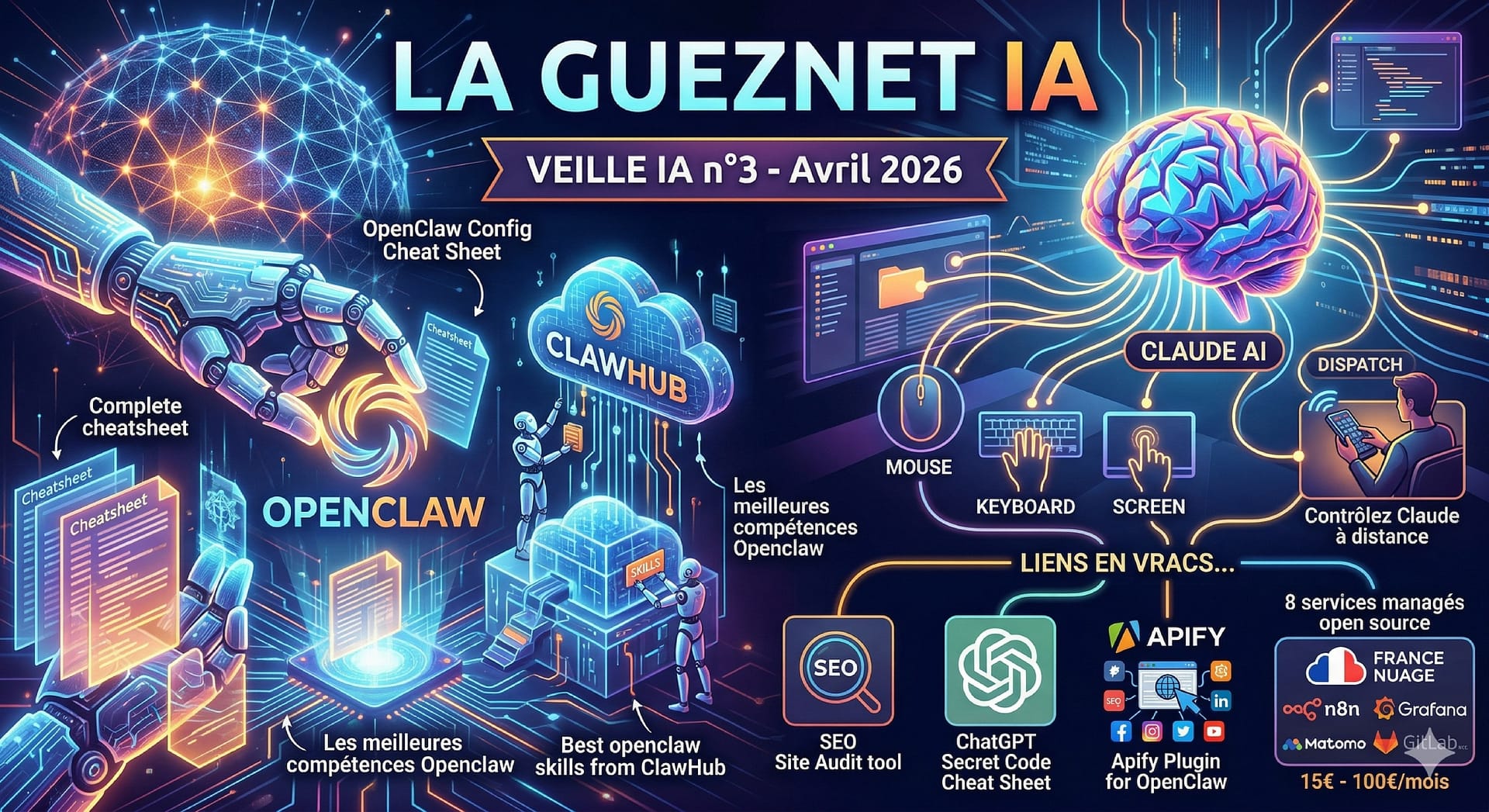
Liens en vracs…
- Complete cheatsheet for openclaw https://www.facebook.com/groups/1577315533418837/permalink/1619346575882399/
- OpenClaw Config Cheat Sheet : https://openclaw213.sademo.xyz/downloads/openclaw-cheatsheet.pdf
- SEO Site audit tool : Analyze your Web Page https://pageaudit.com/ (Via https://www.instagram.com/p/DV8qikaDbiz/)
- ChatGPT Secret Code Cheat Sheet – 50 Power Commands! https://tools.eq4c.com/prompt/chatgpt-secret-code-cheat-sheet-50-power-commands/
- Les meilleures compétences Openclaw que tu devrais installer (tirées des 500+ compétences de ClawHub)
https://www.reddit.com/r/AI_Agents/comments/1r2u356/best_openclaw_skills_you_should_install_from/
- Best openclaw skills from ClawHub https://www.reddit.com/answers/d3b0ffa0-b10d-4173-8f0c-130537802661/
- 8 services managés open source, hébergés en France, de 15 à 100 €/mois : n8n, Grafana, Matomo, Vaultwarden, GitLab CI Runner, Metabase, Odoo, … https://france-nuage.fr/tarifs
- Apify Plugin for OpenClaw: Universal web scraping and data extraction via Apify — 57+ Actors across Instagram, Facebook, TikTok, YouTube, Google Maps, Google Search, e-commerce, and more. OpenClaw agents can browse the web, but they can’t reliably extract structured data at scale. The new Apify plugin for OpenClaw fixes this. https://github.com/apify/apify-openclaw-plugin/
- Today, we’re releasing a feature that allows Claude to control your computer: Mouse, keyboard, and screen, giving it the ability to use any app. I believe this is especially useful if used with Dispatch, which allows you to remotely control Claude on your computer while you’re away. https://x.com/felixrieseberg/status/2036193240509235452
https://claude.com/download - Today we are launching the Kapso CLI: WhatsApp numbers for agents. https://kapso.ai 1️⃣ npm install -g @kapso/cli 2️⃣ kapso setup. Done, your agent has a WhatsApp number.
- Microsoft just changed the game. They open-sourced a tool that converts literally any file into clean markdown for LLMs in under 60 seconds. MarkItDown now offers an MCP (Model Context Protocol) server for integration with LLM applications like Claude Desktop. 100% open source. https://github.com/microsoft/markitdown
- Anthropic just published their internal playbook on what actually matters: XML-structured prompting. Replace your next prompt with:
<task>[What you want]</task>
<context>[Background info]</context>
<constraints>[Limitations]</constraints>
<output_format>[How to structure response]</output_format>
https://x.com/heyrimsha/status/2035319386740068698
- VidBee is a modern, open-source video downloader that lets you download videos and audios from 1000+ websites worldwide.
https://github.com/nexmoe/VidBee/
- FreeCut video editor http://freecut.net https://github.com/walterlow/freecut FreeCut is a browser-based multi-track video editor. No installation, no uploads — everything runs locally in your browser using WebCodecs, OPFS, and the File System Access API.
- PDF editor https://x.com/i/status/2034741437447745687 25MB only. No signup. No internet needed. Edits actual text, not just draws over it. 100% free desktop version. https://github.com/Pawandeep-prog/revpdf-release – https://revpdf.com
- It’s called ClawRouter. It looks at every AI request you send and automatically routes it to the cheapest model that can handle it.
https://x.com/hasantoxr/status/2035283282259317127 / https://github.com/BlockRunAI/ClawRouter
You send a prompt:
→ ClawRouter scores it across 14 dimensions in under 1 millisecond
→ Simple question? Routes to the cheapest model
→ Complex coding task? Routes to Claude or GPT
- Google vient de sortir Stitch. Qualité meilleure que 80% des freelances sur Malt. Je lui ai filé mes idées, mon copywriting. Il m’a sorti une landing page complète avec design system, 5 sections, et le front intégré. Temps passé : 10 minutes. Coût : 0€. On en parle ou on fait semblant de pas voir ? Design at the speed of AI : https://stitch.withgoogle.com/
https://x.com/NumaBuilds/status/2035017771797365152
- Someone built a fully local deep research agent that writes its own search queries, hunts down sources, finds the gaps in its own answers, then keeps searching until it’s done. It’s called Local Deep Researcher. Drop in any Ollama model like DeepSeek, Llama, Qwen and give it a topic. It handles everything:
→ Generates the search query
→ Scrapes the web
→ Summarizes what it found
→ Identifies what it missed
→ Searches again to fill the gaps
→ Outputs a full markdown report with citations
https://x.com/ihtesham2005/status/2035009684386771306
https://github.com/langchain-ai/local-deep-researcher
- **page-agent.js** — a GUI agent that lives directly inside your webpage. No Selenium. No Puppeteer. No Chrome extension. No Python backend. Just one script tag. It reads your DOM as text (no screenshots, no multimodal BS), brings your own LLM, and executes natural language commands like « fill out this form » or « click login » — right inside the page.
https://x.com/NainsiDwiv50980/status/2034907880462414024
https://github.com/alibaba/page-agent
- China has released an AI employee that runs 100% locally. It can do research, code, build websites, create slide decks, and generate videos.. all by itself. And it comes with its own computer. 100% Open Source. DeerFlow – 2.0 : DeerFlow (Deep Exploration and Efficient Research Flow) is an open-source super agent harness that orchestrates sub-agents, memory, and sandboxes to do almost anything — powered by extensible skills.
https://x.com/dr_cintas/status/2035387052460536293
https://github.com/bytedance/deer-flow
ChatGPT Secret Code Cheat Sheet
ChatGPT Secret Code Cheat Sheet – 50 Power Commands!
https://tools.eq4c.com/prompt/chatgpt-secret-code-cheat-sheet-50-power-commands/
Use these simple codes to supercharge your ChatGPT prompts for faster, clearer, and smarter outputs. I’ve been collecting these for months and finally compiled the ultimate list. Bookmark this!
Foundational Shortcuts
Simplifies complex topics in plain language. ELI5 (Explain Like I’m 5)
Usage: ELI5: blockchain technology
Condenses lengthy content into a quick summary.
Usage: TL;DR: [paste content]
Breaks down tasks into clear steps.
Usage: Explain how to build a website STEP-BY-STEP
Creates actionable checklists from your prompt.
Usage: CHECKLIST: Launching a YouTube Channel
Generates high-level summaries.
Usage: EXEC SUMMARY: [paste report]
Creates structured outlines for any topic.
Usage: OUTLINE: Content marketing strategy
Builds structured approaches to problems.
Usage: FRAMEWORK: Time management system
Makes text sound professional or technical.
Usage: JARGON: Benefits of cloud computing
Writes in a conversational, natural tone.
Usage: HUMANIZE: Write a thank-you email
Customizes output for a specific audience.
Usage: AUDIENCE: Teenagers — Explain healthy eating
Sets tone (casual, formal, humorous, etc.).
Usage: TONE: Friendly — Write a welcome message
Start with context, end with format:
CONTEXT: B2B SaaS startup | AUDIENCE: Investors | EXEC SUMMARY | FORMAT AS: Presentation slides
Everything Claude Code
https://github.com/affaan-m/everything-claude-code
Everything Claude Code: The performance optimization system for AI agent harnesses. From an Anthropic hackathon winner.
Not just configs. A complete system: skills, instincts, memory optimization, continuous learning, security scanning, and research-first development. Production-ready agents, skills, hooks, rules, MCP configurations, and legacy command shims evolved over 10+ months of intensive daily use building real products. Works across Claude Code, Codex, Cowork, and other AI agent harnesses.
→ Memory: Saves project context so the AI picks up where you left off
→ Learning: Turns your coding patterns into reusable skills
→ Teamwork: Uses sub-agents to bypass context limits
→ Cost saving: Slims prompts to reduce API spend
→ Testing: Verifies its own code before finalizing
→ Speed: Runs multiple agents in parallel via git worktrees
This repo is a Claude Code plugin – install it directly or copy components manually.
|-- .claude-plugin/   # Plugin and marketplace manifests
|   |-- plugin.json         # Plugin metadata and component paths
|   |-- marketplace.json    # Marketplace catalog for /plugin marketplace add
|
|-- agents/           # 36 specialized subagents for delegation
|   |-- planner.md           # Feature implementation planning
|   |-- architect.md         # System design decisions
|   |-- tdd-guide.md         # Test-driven development
|   |-- code-reviewer.md     # Quality and security review
|   |-- security-reviewer.md # Vulnerability analysis
|   |-- build-error-resolver.md
|   |-- e2e-runner.md        # Playwright E2E testing
|   |-- refactor-cleaner.md  # Dead code cleanup
|   |-- doc-updater.md       # Documentation sync
|   |-- docs-lookup.md       # Documentation/API lookup
|   |-- chief-of-staff.md    # Communication triage and drafts
|   |-- loop-operator.md     # Autonomous loop execution
|   |-- harness-optimizer.md # Harness config tuning
|   |-- cpp-reviewer.md      # C++ code review
|   |-- cpp-build-resolver.md # C++ build error resolution
|   |-- go-reviewer.md       # Go code review
|   |-- go-build-resolver.md # Go build error resolution
|   |-- python-reviewer.md   # Python code review
|   |-- database-reviewer.md # Database/Supabase review
|   |-- typescript-reviewer.md # TypeScript/JavaScript code review
|   |-- java-reviewer.md     # Java/Spring Boot code review
|   |-- java-build-resolver.md # Java/Maven/Gradle build errors
|   |-- kotlin-reviewer.md   # Kotlin/Android/KMP code review
|   |-- kotlin-build-resolver.md # Kotlin/Gradle build errors
|   |-- rust-reviewer.md     # Rust code review
|   |-- rust-build-resolver.md # Rust build error resolution
|   |-- pytorch-build-resolver.md # PyTorch/CUDA training errors
|
|-- skills/           # Workflow definitions and domain knowledge
|   |-- coding-standards/           # Language best practices
|   |-- clickhouse-io/              # ClickHouse analytics, queries, data engineering
|   |-- backend-patterns/           # API, database, caching patterns
|   |-- frontend-patterns/          # React, Next.js patterns
|   |-- frontend-slides/            # HTML slide decks and PPTX-to-web presentation workflows (NEW)
|   |-- article-writing/            # Long-form writing in a supplied voice without generic AI tone (NEW)
|   |-- content-engine/             # Multi-platform social content and repurposing workflows (NEW)
|   |-- market-research/            # Source-attributed market, competitor, and investor research (NEW)
|   |-- investor-materials/         # Pitch decks, one-pagers, memos, and financial models (NEW)
|   |-- investor-outreach/          # Personalized fundraising outreach and follow-up (NEW)
|   |-- continuous-learning/        # Auto-extract patterns from sessions (Longform Guide)
|   |-- continuous-learning-v2/     # Instinct-based learning with confidence scoring
|   |-- iterative-retrieval/        # Progressive context refinement for subagents
|   |-- strategic-compact/          # Manual compaction suggestions (Longform Guide)
|   |-- tdd-workflow/               # TDD methodology
|   |-- security-review/            # Security checklist
|   |-- eval-harness/               # Verification loop evaluation (Longform Guide)
|   |-- verification-loop/          # Continuous verification (Longform Guide)
|   |-- videodb/                   # Video and audio: ingest, search, edit, generate, stream (NEW)
|   |-- golang-patterns/            # Go idioms and best practices
|   |-- golang-testing/             # Go testing patterns, TDD, benchmarks
|   |-- cpp-coding-standards/         # C++ coding standards from C++ Core Guidelines (NEW)
|   |-- cpp-testing/                # C++ testing with GoogleTest, CMake/CTest (NEW)
|   |-- django-patterns/            # Django patterns, models, views (NEW)
|   |-- django-security/            # Django security best practices (NEW)
|   |-- django-tdd/                 # Django TDD workflow (NEW)
|   |-- django-verification/        # Django verification loops (NEW)
|   |-- laravel-patterns/           # Laravel architecture patterns (NEW)
|   |-- laravel-security/           # Laravel security best practices (NEW)
|   |-- laravel-tdd/                # Laravel TDD workflow (NEW)
|   |-- laravel-verification/       # Laravel verification loops (NEW)
|   |-- python-patterns/            # Python idioms and best practices (NEW)
|   |-- python-testing/             # Python testing with pytest (NEW)
|   |-- springboot-patterns/        # Java Spring Boot patterns (NEW)
|   |-- springboot-security/        # Spring Boot security (NEW)
|   |-- springboot-tdd/             # Spring Boot TDD (NEW)
|   |-- springboot-verification/    # Spring Boot verification (NEW)
|   |-- configure-ecc/              # Interactive installation wizard (NEW)
|   |-- security-scan/              # AgentShield security auditor integration (NEW)
|   |-- java-coding-standards/     # Java coding standards (NEW)
|   |-- jpa-patterns/              # JPA/Hibernate patterns (NEW)
|   |-- postgres-patterns/         # PostgreSQL optimization patterns (NEW)
|   |-- nutrient-document-processing/ # Document processing with Nutrient API (NEW)
|   |-- project-guidelines-example/   # Template for project-specific skills
|   |-- database-migrations/         # Migration patterns (Prisma, Drizzle, Django, Go) (NEW)
|   |-- api-design/                  # REST API design, pagination, error responses (NEW)
|   |-- deployment-patterns/         # CI/CD, Docker, health checks, rollbacks (NEW)
|   |-- docker-patterns/            # Docker Compose, networking, volumes, container security (NEW)
|   |-- e2e-testing/                 # Playwright E2E patterns and Page Object Model (NEW)
|   |-- content-hash-cache-pattern/  # SHA-256 content hash caching for file processing (NEW)
|   |-- cost-aware-llm-pipeline/     # LLM cost optimization, model routing, budget tracking (NEW)
|   |-- regex-vs-llm-structured-text/ # Decision framework: regex vs LLM for text parsing (NEW)
|   |-- swift-actor-persistence/     # Thread-safe Swift data persistence with actors (NEW)
|   |-- swift-protocol-di-testing/   # Protocol-based DI for testable Swift code (NEW)
|   |-- search-first/               # Research-before-coding workflow (NEW)
|   |-- skill-stocktake/            # Audit skills and commands for quality (NEW)
|   |-- liquid-glass-design/         # iOS 26 Liquid Glass design system (NEW)
|   |-- foundation-models-on-device/ # Apple on-device LLM with FoundationModels (NEW)
|   |-- swift-concurrency-6-2/       # Swift 6.2 Approachable Concurrency (NEW)
|   |-- perl-patterns/             # Modern Perl 5.36+ idioms and best practices (NEW)
|   |-- perl-security/             # Perl security patterns, taint mode, safe I/O (NEW)
|   |-- perl-testing/              # Perl TDD with Test2::V0, prove, Devel::Cover (NEW)
|   |-- autonomous-loops/           # Autonomous loop patterns: sequential pipelines, PR loops, DAG orchestration (NEW)
|   |-- plankton-code-quality/      # Write-time code quality enforcement with Plankton hooks (NEW)
|
|-- commands/         # Legacy slash-entry shims; prefer skills/
|   |-- tdd.md              # /tdd - Test-driven development
|   |-- plan.md             # /plan - Implementation planning
|   |-- e2e.md              # /e2e - E2E test generation
|   |-- code-review.md      # /code-review - Quality review
|   |-- build-fix.md        # /build-fix - Fix build errors
|   |-- refactor-clean.md   # /refactor-clean - Dead code removal
|   |-- learn.md            # /learn - Extract patterns mid-session (Longform Guide)
|   |-- learn-eval.md       # /learn-eval - Extract, evaluate, and save patterns (NEW)
|   |-- checkpoint.md       # /checkpoint - Save verification state (Longform Guide)
|   |-- verify.md           # /verify - Run verification loop (Longform Guide)
|   |-- setup-pm.md         # /setup-pm - Configure package manager
|   |-- go-review.md        # /go-review - Go code review (NEW)
|   |-- go-test.md          # /go-test - Go TDD workflow (NEW)
|   |-- go-build.md         # /go-build - Fix Go build errors (NEW)
|   |-- skill-create.md     # /skill-create - Generate skills from git history (NEW)
|   |-- instinct-status.md  # /instinct-status - View learned instincts (NEW)
|   |-- instinct-import.md  # /instinct-import - Import instincts (NEW)
|   |-- instinct-export.md  # /instinct-export - Export instincts (NEW)
|   |-- evolve.md           # /evolve - Cluster instincts into skills
|   |-- prune.md            # /prune - Delete expired pending instincts (NEW)
|   |-- pm2.md              # /pm2 - PM2 service lifecycle management (NEW)
|   |-- multi-plan.md       # /multi-plan - Multi-agent task decomposition (NEW)
|   |-- multi-execute.md    # /multi-execute - Orchestrated multi-agent workflows (NEW)
|   |-- multi-backend.md    # /multi-backend - Backend multi-service orchestration (NEW)
|   |-- multi-frontend.md   # /multi-frontend - Frontend multi-service orchestration (NEW)
|   |-- multi-workflow.md   # /multi-workflow - General multi-service workflows (NEW)
|   |-- orchestrate.md      # /orchestrate - Multi-agent coordination
|   |-- sessions.md         # /sessions - Session history management
|   |-- eval.md             # /eval - Evaluate against criteria
|   |-- test-coverage.md    # /test-coverage - Test coverage analysis
|   |-- update-docs.md      # /update-docs - Update documentation
|   |-- update-codemaps.md  # /update-codemaps - Update codemaps
|   |-- python-review.md    # /python-review - Python code review (NEW)
|
|-- rules/            # Always-follow guidelines (copy to ~/.claude/rules/)
|   |-- README.md            # Structure overview and installation guide
|   |-- common/              # Language-agnostic principles
|   |   |-- coding-style.md    # Immutability, file organization
|   |   |-- git-workflow.md    # Commit format, PR process
|   |   |-- testing.md         # TDD, 80% coverage requirement
|   |   |-- performance.md     # Model selection, context management
|   |   |-- patterns.md        # Design patterns, skeleton projects
|   |   |-- hooks.md           # Hook architecture, TodoWrite
|   |   |-- agents.md          # When to delegate to subagents
|   |   |-- security.md        # Mandatory security checks
|   |-- typescript/          # TypeScript/JavaScript specific
|   |-- python/              # Python specific
|   |-- golang/              # Go specific
|   |-- swift/               # Swift specific
|   |-- php/                 # PHP specific (NEW)
|
|-- hooks/            # Trigger-based automations
|   |-- README.md                 # Hook documentation, recipes, and customization guide
|   |-- hooks.json                # All hooks config (PreToolUse, PostToolUse, Stop, etc.)
|   |-- memory-persistence/       # Session lifecycle hooks (Longform Guide)
|   |-- strategic-compact/        # Compaction suggestions (Longform Guide)
|
|-- scripts/          # Cross-platform Node.js scripts (NEW)
|   |-- lib/                     # Shared utilities
|   |   |-- utils.js             # Cross-platform file/path/system utilities
|   |   |-- package-manager.js   # Package manager detection and selection
|   |-- hooks/                   # Hook implementations
|   |   |-- session-start.js     # Load context on session start
|   |   |-- session-end.js       # Save state on session end
|   |   |-- pre-compact.js       # Pre-compaction state saving
|   |   |-- suggest-compact.js   # Strategic compaction suggestions
|   |   |-- evaluate-session.js  # Extract patterns from sessions
|   |-- setup-package-manager.js # Interactive PM setup
|
|-- tests/            # Test suite (NEW)
|   |-- lib/                     # Library tests
|   |-- hooks/                   # Hook tests
|   |-- run-all.js               # Run all tests
|
|-- contexts/         # Dynamic system prompt injection contexts (Longform Guide)
|   |-- dev.md              # Development mode context
|   |-- review.md           # Code review mode context
|   |-- research.md         # Research/exploration mode context
|
|-- examples/         # Example configurations and sessions
|   |-- CLAUDE.md             # Example project-level config
|   |-- user-CLAUDE.md        # Example user-level config
|   |-- saas-nextjs-CLAUDE.md   # Real-world SaaS (Next.js + Supabase + Stripe)
|   |-- go-microservice-CLAUDE.md # Real-world Go microservice (gRPC + PostgreSQL)
|   |-- django-api-CLAUDE.md      # Real-world Django REST API (DRF + Celery)
|   |-- laravel-api-CLAUDE.md     # Real-world Laravel API (PostgreSQL + Redis) (NEW)
|   |-- rust-api-CLAUDE.md        # Real-world Rust API (Axum + SQLx + PostgreSQL) (NEW)
|
|-- mcp-configs/      # MCP server configurations
|   |-- mcp-servers.json    # GitHub, Supabase, Vercel, Railway, etc.
|
|-- marketplace.json  # Self-hosted marketplace config (for /plugin marketplace add)
Minimalist Entrepreneur Claude
https://x.com/shl/status/2036162956761715096
https://github.com/slavingia/skills
I turned The Minimalist Entrepreneur into 9 Claude Code skills.
/find-community — find your people
/validate-idea — test before you build
/mvp — ship in a weekend
/first-customers — sell to 100 people
/pricing — charge something
/marketing-plan — make fans, not headlines
/grow-sustainably — spend less than you make
/company-values — define your culture
/minimalist-review — gut-check any decision
| Skill | Command | When to use |
| Find Community | /find-community | Looking for a business idea, trying to find your community |
| Validate Idea | /validate-idea | Testing if a business idea is worth pursuing |
| MVP | /mvp | Ready to build your first product, struggling with scope |
| Processize | /processize | Have a product idea, want to deliver value by hand before writing code |
| First Customers | /first-customers | Have a product, need to find your first 100 customers |
| Pricing | /pricing | Setting prices, considering price changes |
| Marketing Plan | /marketing-plan | Have product-market fit, ready to scale with content |
| Grow Sustainably | /grow-sustainably | Making decisions about spending, hiring, or scaling |
| Company Values | /company-values | Defining culture, preparing to hire |
| Minimalist Review | /minimalist-review | Gut-checking any business decision |
SEO Competitors
My site is https://julienweb.fr/ Scan these competitors websites:
https://devsource.fr/ , https://www.net-concept.fr/ , https://www.epixelic.com/creation-site-internet-pantin
- Identify missing content, weak pages, and under-optimized sections
- Highlight keyword gaps not being targeted
- Find trust gaps (testimonials, case studies)
output:
- Top 5 content gaps
- 5 high-impact topics to outperform them
- Why these will rank
Be specific. No generic SEO advice.
List 20 high-intent local keywords
for « creation de site » in « region 93, pantin, aubervilliers, bobigny, … »
Requirements:
- Signal immediate buying intent (« near me », « emergency », « same day »)
- Include long-tail variations
- Prioritize low competition + high conversion
Output format:
keyword + intent type + why it converts.
AI tools to build a faceless channel on YouTube
https://www.instagram.com/p/DWrmthdjOMO/
Prompt 1: Setup and Analyze the Target
Channel Go to a monetized, high-view channel in your niche, copy 10-15 of their top-performing video links at once, and paste them into a new NotebookLM as « Sources. » Then, extract their formula:
« I have uploaded links from top-performing videos in this niche. Read these sources and break down their exact script structure, video topics, hook styles, pacing, and overall tone. Give me a detailed summary of the blueprint that makes this channel successful. »
Prompt 2: Channel Name Ideas
« Based on your analysis of the proven patterns in these sources, generate 10 unique, memorable YouTube channel name ideas. These names should establish authority and appeal directly to the audience that watches the source content. »
Prompt 3: Video Idea Creator
« Using the content gaps and popular themes from our source analysis, generate 10 highly engaging video ideas for my new channel. For each idea, include a working title and a brief description of the core message to ensure maximum watch time. »
Prompt 4: Script and Hook Writer
« I want to make a video about [insert chosen idea from previous step]. Act as a professional YouTube scriptwriter. Using the exact pacing and tone from the successful sources we analyzed, write a complete script. Include a powerful 5-second hook, a problem setup, value delivery, and a natural call to action. »
Prompt 5: Clickable Title Maker
« Review the video script we just created. Act as a YouTube click-through rate expert and generate 10 irresistible video titles. The titles should spark intense curiosity, promise a clear benefit, and perfectly match the style of the top-performing videos in our sources. »
Prompt 6: Cover Image Planner
« Based on the titles we generated, give me 5 simple, high-converting thumbnail concepts that I can easily design in a tool like Canva. Tell me exactly what short text to use, the color scheme (like red, black, and white), and what simple visual elements (like a stick figure or graph) to include. »
Prompt 7: Audio Generation Setup
« Summarize this entire video script and its core emotional beats into a concise, detailed brief. I will use this summary to feed into NotebookLM’s ‘Audio Overview’ feature so it generates a perfect, high-retention podcast-style voiceover for the final video. »
Learn prompting
- OpenAI Documentation
https://developers.openai.com/api/docs/guides/prompting - Anthropic Prompting Guide
https://anthropic.skilljar.com - DeepLearningAI Short Courses
https://deeplearning.ai/short-courses/ - Prompt Engineering Guide
https://github.com/dair-ai/Prompt-Engineering-Guide - Awesome ChatGPT Prompts
https://github.com/f/awesome-chatgpt-prompts
Design systems
https://x.com/heynavtoor/status/2040339518822432893
https://github.com/VoltAgent/awesome-design-md
Someone reverse-engineered the design systems of Apple, Spotify, Airbnb, and 30+ billion-dollar companies.
Packed each one into a single file. Free. It’s called Awesome Design MD. Drop one file into your project. Your AI agent builds UI that looks like Spotify. Or Apple. Or Airbnb. Instantly. Not screenshots. Not Figma links. A single DESIGN .md file that captures every color, font, spacing value, button style, and layout pattern from a real website. In a format AI agents read and reproduce.
Here’s what’s inside:
→ Apple. Premium white space, SF Pro typography, cinematic imagery.
→ Spotify. Vibrant green on dark, bold type, album-art-driven layout.
→ Airbnb. Warm coral accent, photography-driven, rounded UI.
→ Linear. Ultra-minimal, precise spacing, purple accent.
→ SpaceX. Stark black and white, full-bleed imagery, futuristic.
→ BMW. Dark premium surfaces, precise German engineering aesthetic.
→ NVIDIA. Green-black energy, technical power aesthetic.
→ Uber. Bold black and white, tight type, urban energy.
→ Sentry, PostHog, Raycast, Cursor, ElevenLabs, and 20+ more.
Here’s how to use it:
→ Pick a design system from the collection
→ Copy the DESIGN .md file into your project root
→ Tell your AI agent to use it
→ Get UI that matches the design language of a billion-dollar company
Prompts pour du contenu viral
https://www.instagram.com/reels/DWeP8XzjPN6/
1️⃣ Le prompt pour du contenu viral
« Agis en tant que stratège de croissance sur les réseaux sociaux. Analyse les 10 dernières tendances virales sur Instagram dans [ta niche] et génère 5 idées de Reels capables d’arrêter le scroll avec un fort potentiel de partage. Sois précis. Pas de bla-bla. »
2️⃣ Transformer la douleur en accroche (Hook)
« Liste les 10 plus grandes frustrations de [ton audience] concernant [sujet]. Transforme chacune d’elles en une accroche audacieuse et percutante (10 mots max). Sois direct. Sois provocateur. »
3️⃣ Le script de Reel qui retient l’attention
« Écris un Reel Instagram de 30 secondes sur [sujet] en utilisant cette structure :
Accroche qui brise le pattern (Pattern-interrupt)
Histoire courte et pertinente
Appel à l’action (CTA) clair pour commenter ou enregistrer. Utilise des phrases simples. Supprime tout le remplissage. »
4️⃣ La preuve sociale qui booste la confiance
« Prends ce résultat [insérer résultat] et crée 5 phrases courtes à mettre en texte sur l’écran qui suscitent la curiosité et la crédibilité. Max 10 mots chacune. »
5️⃣ Le contenu impossible à ne pas enregistrer
« Liste 5 astuces pratiques et méconnues sur [sujet]. Chaque astuce doit faire moins de 12 mots et être immédiatement exploitable. Conçues pour être impossibles à ne pas sauvegarder. »
6️⃣ Recycler comme une machine
« Transforme ce texte [coller le texte] en : • un script de Reel de 7 secondes • un carrousel de 5 slides • un post statique avec une affirmation forte. Adapte le ton et le format pour chacun. »
SEO perform for a Keyword
https://www.instagram.com/p/DVvyog2GiHM/
Search 3 best sites for a keyword in google. Now paste those pages into ChatGPT and use this exact prompt:
- https://digitalmarketinginstitute.com/blog/what-is-seo
- https://seositecheckup.com/
- https://www.searchenginejournal.com/seo/
These are the top three performing pages for this keyword. Analyze them and write a better SEO and reader-friendly piece of content so that my page ranks better than these.
Go to Google and type:
Site:yourwebsite.com « keyword »
Replace « keyword » with what you sell.
Go to https://answerthepublic.com and type in what you sell… Turn those questions into blog posts. Answer them clearly and thoroughly. This builds « Topical Authority » and it’s how you get ranked.
Build your own ai clone
https://www.instagram.com/p/DWHlRKegMW0/
I cloned myself with claude in one hour. now my ai twin works 24/7, creating, selling, and growing my business while i sleep. Here are 7 prompts to build your own ai clone from scratch:
- Identity Builder : Analyze my writing style, tone, and mindset from this text: [paste sample]. Create a detailed personality profile for my Al clone. »
- Communication Trainer : Train my Al clone to reply like me, same tone, vocabulary and emotional intelligence. Include examples for different scenarios. »
- Content Creator : Make my Al clone create daily content (tweets, carousels, captions) using my personality and niche. Keep everything brand-consistent. »
- Offer Seller : *Train my Al clone to write persuasive Dis and replies that turn curious followers into paying clients, without sounding salesy. »
- Decision Engine : Build a framework so my Al clone can make smart business decisions based on my values, audience targets, « goals, and income
- Client Communicator : « *Make my Al clone manage client messages, updates, and feedback, in my exact tone and level of professionalism. »
- Daily Operator : « Design a system for my Al clone to plan, post, and analyze content performance automatically every day. »
4 Claude Code Prompts That Turn It Into a Super-Employee
https://www.instagram.com/p/DVtju8nERti/
Your Claude Code will never forget again send Claude this message
Create a persistent memory system for yourself. Makea /memory directory with files organized by category: decisions.md, people.md, preferences.md, and user.md. Write a CLAUDE. md that instructs you to read these files at the start of every session and update them at the end.
Hold yourself accountable
Create a decision logging system. Every time I describe a decision I’m making, log it to decisions.csv with: date, decision, reasoning, expected outcome, and a 30-day review date. Set up a cron job that checks daily if any decisions have hit their review date and appends a « REVIEW DUE » flag. Build a review.sh script that surfaces only those flagged items.
Clean up your inbox
Build an hourly cron job that scans my Gmail inbox, triages new emails into URGENT / NEEDS REPLY / FYI / JUNK, auto-labels using my existing labels (infer meaning from history), and saves drafted replies for URGENT and NEEDS REPLY emails – tone-matched to my last 20 sent emails. Never auto-send. You already have access to the Google Workspace CLI, and my (Tyler Germain’ s) Workspace CLI Skill from AI Innovators. Store state in emails_processed.json. Log to inbox_manager.log.
Hold yourself accountable (2)
Build a to-do dashboard with a local web UI. I can add, edit, and delete tasks with priority levels. Set up an hourly cron job – if the task list is not empty, work through tasks autonomously starting with highest priority, Log what was done, and mark complete. Store tasks in tasks.json. Log all activity to tasks.log.
4 prompts pour Claude code® qui le transforment en super-employé.
01 CLAUDE CODE N’OUBLIERA PLUS JAMAIS
Crée un système de mémoire persistante pour toi-même. Fais un répertoire /memory avec des fichiers organisés par catégorie : decisions.md, people.md, preferences.md, et user.md. Écris un CLAUDE.md qui t’instruit de lire ces fichiers au début de chaque session et de les mettre à jour à la fin.
02 RESTE RESPONSABLE DE TES DÉCISIONS
Crée un système de journalisation des décisions. Chaque fois que je décris une décision que je prends, enregistre-la dans decisions.csv avec : date, décision, raisonnement, résultat attendu, et une date de révision à 30 jours. Configure un cron job qui vérifie quotidiennement si des décisions ont atteint leur date de révision et ajoute un flag « REVIEW DUE ». Construis un script review.sh qui affiche uniquement les elements flaggés.
03 NETTOIE TA BOÎTE MAIL
Construis un cron job horaire qui scanne ma boîte Gmail, trie les nouveaux emails en URGENT / NEEDS / REPLY / FYI / JUNK, applique automatiquement mes labels existants (en inférant leur sens depuis l’historique), et sauvegarde des brouillons de réponses pour les emails URGENT et NEEDS REPLY – avec un ton calqué sur mes 20 derniers emails envoyés. Jamais d’envoi automatique. Tu as deja acces au Google Workspace CLI et au Norkspace CLI Skill de (Tyler Germain) d Al Innovators. Stocke l’état dans emails_processed.json. Log dans inbox_manager.log.
04 TO-DO AUTONOME
Construis un dashboard to-do avec une Ul web vide, traite les tâches de façon autonome en commençant par la priorité la plus haute, journalise ce qui a été fait, et marque comme terminé. Stocke les tâches dans tasks.json. Log toute l’activité dans tasks.log.
Everything Claude Code
https://github.com/affaan-m/everything-claude-code
A complete system: skills, instincts, memory optimization, continuous learning, security scanning, and research-first development. Production-ready agents, skills, hooks, rules, MCP configurations, and legacy command shims evolved over 10+ months of intensive daily use building real products.
Works across Claude Code, Codex, Cowork, and other AI agent harnesses.
What’s Inside
This repo is a Claude Code plugin – install it directly or copy components manually.
everything-claude-code/
|-- .claude-plugin/   # Plugin and marketplace manifests
|   |-- plugin.json         # Plugin metadata and component paths
|   |-- marketplace.json    # Marketplace catalog for /plugin marketplace add
|
|-- agents/           # 36 specialized subagents for delegation
|   |-- planner.md           # Feature implementation planning
|   |-- architect.md         # System design decisions
|   |-- tdd-guide.md         # Test-driven development
|   |-- code-reviewer.md     # Quality and security review
|   |-- security-reviewer.md # Vulnerability analysis
|   |-- build-error-resolver.md
|   |-- e2e-runner.md        # Playwright E2E testing
|   |-- refactor-cleaner.md  # Dead code cleanup
|   |-- doc-updater.md       # Documentation sync
|   |-- docs-lookup.md       # Documentation/API lookup
|   |-- chief-of-staff.md    # Communication triage and drafts
|   |-- loop-operator.md     # Autonomous loop execution
|   |-- harness-optimizer.md # Harness config tuning
|   |-- cpp-reviewer.md      # C++ code review
|   |-- cpp-build-resolver.md # C++ build error resolution
|   |-- go-reviewer.md       # Go code review
|   |-- go-build-resolver.md # Go build error resolution
|   |-- python-reviewer.md   # Python code review
|   |-- database-reviewer.md # Database/Supabase review
|   |-- typescript-reviewer.md # TypeScript/JavaScript code review
|   |-- java-reviewer.md     # Java/Spring Boot code review
|   |-- java-build-resolver.md # Java/Maven/Gradle build errors
|   |-- kotlin-reviewer.md   # Kotlin/Android/KMP code review
|   |-- kotlin-build-resolver.md # Kotlin/Gradle build errors
|   |-- rust-reviewer.md     # Rust code review
|   |-- rust-build-resolver.md # Rust build error resolution
|   |-- pytorch-build-resolver.md # PyTorch/CUDA training errors
|
|-- skills/           # Workflow definitions and domain knowledge
|   |-- coding-standards/           # Language best practices
|   |-- clickhouse-io/              # ClickHouse analytics, queries, data engineering
|   |-- backend-patterns/           # API, database, caching patterns
|   |-- frontend-patterns/          # React, Next.js patterns
|   |-- frontend-slides/            # HTML slide decks and PPTX-to-web presentation workflows (NEW)
|   |-- article-writing/            # Long-form writing in a supplied voice without generic AI tone (NEW)
|   |-- content-engine/             # Multi-platform social content and repurposing workflows (NEW)
|   |-- market-research/            # Source-attributed market, competitor, and investor research (NEW)
|   |-- investor-materials/         # Pitch decks, one-pagers, memos, and financial models (NEW)
|   |-- investor-outreach/          # Personalized fundraising outreach and follow-up (NEW)
|   |-- continuous-learning/        # Auto-extract patterns from sessions (Longform Guide)
|   |-- continuous-learning-v2/     # Instinct-based learning with confidence scoring
|   |-- iterative-retrieval/        # Progressive context refinement for subagents
|   |-- strategic-compact/          # Manual compaction suggestions (Longform Guide)
|   |-- tdd-workflow/               # TDD methodology
|   |-- security-review/            # Security checklist
|   |-- eval-harness/               # Verification loop evaluation (Longform Guide)
|   |-- verification-loop/          # Continuous verification (Longform Guide)
|   |-- videodb/                   # Video and audio: ingest, search, edit, generate, stream (NEW)
|   |-- golang-patterns/            # Go idioms and best practices
|   |-- golang-testing/             # Go testing patterns, TDD, benchmarks
|   |-- cpp-coding-standards/         # C++ coding standards from C++ Core Guidelines (NEW)
|   |-- cpp-testing/                # C++ testing with GoogleTest, CMake/CTest (NEW)
|   |-- django-patterns/            # Django patterns, models, views (NEW)
|   |-- django-security/            # Django security best practices (NEW)
|   |-- django-tdd/                 # Django TDD workflow (NEW)
|   |-- django-verification/        # Django verification loops (NEW)
|   |-- laravel-patterns/           # Laravel architecture patterns (NEW)
|   |-- laravel-security/           # Laravel security best practices (NEW)
|   |-- laravel-tdd/                # Laravel TDD workflow (NEW)
|   |-- laravel-verification/       # Laravel verification loops (NEW)
|   |-- python-patterns/            # Python idioms and best practices (NEW)
|   |-- python-testing/             # Python testing with pytest (NEW)
|   |-- springboot-patterns/        # Java Spring Boot patterns (NEW)
|   |-- springboot-security/        # Spring Boot security (NEW)
|   |-- springboot-tdd/             # Spring Boot TDD (NEW)
|   |-- springboot-verification/    # Spring Boot verification (NEW)
|   |-- configure-ecc/              # Interactive installation wizard (NEW)
|   |-- security-scan/              # AgentShield security auditor integration (NEW)
|   |-- java-coding-standards/     # Java coding standards (NEW)
|   |-- jpa-patterns/              # JPA/Hibernate patterns (NEW)
|   |-- postgres-patterns/         # PostgreSQL optimization patterns (NEW)
|   |-- nutrient-document-processing/ # Document processing with Nutrient API (NEW)
|   |-- project-guidelines-example/   # Template for project-specific skills
|   |-- database-migrations/         # Migration patterns (Prisma, Drizzle, Django, Go) (NEW)
|   |-- api-design/                  # REST API design, pagination, error responses (NEW)
|   |-- deployment-patterns/         # CI/CD, Docker, health checks, rollbacks (NEW)
|   |-- docker-patterns/            # Docker Compose, networking, volumes, container security (NEW)
|   |-- e2e-testing/                 # Playwright E2E patterns and Page Object Model (NEW)
|   |-- content-hash-cache-pattern/  # SHA-256 content hash caching for file processing (NEW)
|   |-- cost-aware-llm-pipeline/     # LLM cost optimization, model routing, budget tracking (NEW)
|   |-- regex-vs-llm-structured-text/ # Decision framework: regex vs LLM for text parsing (NEW)
|   |-- swift-actor-persistence/     # Thread-safe Swift data persistence with actors (NEW)
|   |-- swift-protocol-di-testing/   # Protocol-based DI for testable Swift code (NEW)
|   |-- search-first/               # Research-before-coding workflow (NEW)
|   |-- skill-stocktake/            # Audit skills and commands for quality (NEW)
|   |-- liquid-glass-design/         # iOS 26 Liquid Glass design system (NEW)
|   |-- foundation-models-on-device/ # Apple on-device LLM with FoundationModels (NEW)
|   |-- swift-concurrency-6-2/       # Swift 6.2 Approachable Concurrency (NEW)
|   |-- perl-patterns/             # Modern Perl 5.36+ idioms and best practices (NEW)
|   |-- perl-security/             # Perl security patterns, taint mode, safe I/O (NEW)
|   |-- perl-testing/              # Perl TDD with Test2::V0, prove, Devel::Cover (NEW)
|   |-- autonomous-loops/           # Autonomous loop patterns: sequential pipelines, PR loops, DAG orchestration (NEW)
|   |-- plankton-code-uality/      # Write-time code quality enforcement with Plankton hooks (NEW)
|
|-- commands/         # Legacy slash-entry shims; prefer skills/
|   |-- tdd.md              # /tdd - Test-driven development
|   |-- plan.md             # /plan - Implementation planning
|   |-- e2e.md              # /e2e - E2E test generation
|   |-- code-review.md      # /code-review - Quality review
|   |-- build-fix.md        # /build-fix - Fix build errors
|   |-- refactor-clean.md   # /refactor-clean - Dead code removal
|   |-- learn.md            # /learn - Extract patterns mid-session (Longform Guide)
|   |-- learn-eval.md       # /learn-eval - Extract, evaluate, and save patterns (NEW)
|   |-- checkpoint.md       # /checkpoint - Save verification state (Longform Guide)
|   |-- verify.md           # /verify - Run verification loop (Longform Guide)
|   |-- setup-pm.md         # /setup-pm - Configure package manager
|   |-- go-review.md        # /go-review - Go code review (NEW)
|   |-- go-test.md          # /go-test - Go TDD workflow (NEW)
|   |-- go-build.md         # /go-build - Fix Go build errors (NEW)
|   |-- skill-create.md     # /skill-create - Generate skills from git history (NEW)
|   |-- instinct-status.md  # /instinct-status - View learned instincts (NEW)
|   |-- instinct-import.md  # /instinct-import - Import instincts (NEW)
|   |-- instinct-export.md  # /instinct-export - Export instincts (NEW)
|   |-- evolve.md           # /evolve - Cluster instincts into skills
|   |-- prune.md            # /prune - Delete expired pending instincts (NEW)
|   |-- pm2.md              # /pm2 - PM2 service lifecycle management (NEW)
|   |-- multi-plan.md       # /multi-plan - Multi-agent task decomposition (NEW)
|   |-- multi-execute.md    # /multi-execute - Orchestrated multi-agent workflows (NEW)
|   |-- multi-backend.md    # /multi-backend - Backend multi-service orchestration (NEW)
|   |-- multi-frontend.md   # /multi-frontend - Frontend multi-service orchestration (NEW)
|   |-- multi-workflow.md   # /multi-workflow - General multi-service workflows (NEW)
|   |-- orchestrate.md      # /orchestrate - Multi-agent coordination
|   |-- sessions.md         # /sessions - Session history management
|   |-- eval.md             # /eval - Evaluate against criteria
|   |-- test-coverage.md    # /test-coverage - Test coverage analysis
|   |-- update-docs.md      # /update-docs - Update documentation
|   |-- update-codemaps.md  # /update-codemaps - Update codemaps
|   |-- python-review.md    # /python-review - Python code review (NEW)
|
|-- rules/            # Always-follow guidelines (copy to ~/.claude/rules/)
|   |-- README.md            # Structure overview and installation guide
|   |-- common/              # Language-agnostic principles
|   |   |-- coding-style.md    # Immutability, file organization
|   |   |-- git-workflow.md    # Commit format, PR process
|   |   |-- testing.md         # TDD, 80% coverage requirement
|   |   |-- performance.md     # Model selection, context management
|   |   |-- patterns.md        # Design patterns, skeleton projects
|   |   |-- hooks.md           # Hook architecture, TodoWrite
|   |   |-- agents.md          # When to delegate to subagents
|   |   |-- security.md        # Mandatory security checks
|   |-- typescript/          # TypeScript/JavaScript specific
|   |-- python/              # Python specific
|   |-- golang/              # Go specific
|   |-- swift/               # Swift specific
|   |-- php/                 # PHP specific (NEW)
|
|-- hooks/            # Trigger-based automations
|   |--README.md                 # Hook documentation, recipes, and customization guide
|   |-- hooks.json                # All hooks config (PreToolUse, PostToolUse, Stop, etc.)
|   |-- memory-persistence/       # Session lifecycle hooks (Longform Guide)
|   |-- strategic-compact/        # Compaction suggestions (Longform Guide)
|
|-- scripts/          # Cross-platform Node.js scripts (NEW)
|   |-- lib/                     # Shared utilities
|   |   |-- utils.js             # Cross-platform file/path/system utilities
|   |   |-- package-manager.js   # Package manager detection and selection
|   |-- hooks/                   # Hook implementations
|   |   |-- session-start.js     # Load context on session start
|   |   |-- session-end.js       # Save state on session end
|   |   |-- pre-compact.js       # Pre-compaction state saving
|   |   |-- suggest-compact.js   # Strategic compaction suggestions
|   |   |-- evaluate-session.js  # Extract patterns from sessions
|   |-- setup-package-manager.js # Interactive PM setup
|
|-- tests/            # Test suite (NEW)
|   |-- lib/                     # Library tests
|   |-- hooks/                   # Hook tests
|   |-- run-all.js               # Run all tests
|
|-- contexts/         # Dynamic system prompt injection contexts (Longform Guide)
|   |-- dev.md              # Development mode context
|   |-- review.md           # Code review mode context
|   |-- research.md         # Research/exploration mode context
|
|-- examples/         # Example configurations and sessions
|   |-- CLAUDE.md             # Example project-level config
|   |-- user-CLAUDE.md        # Example user-level config
|   |-- saas-nextjs-CLAUDE.md   # Real-world SaaS (Next.js + Supabase + Stripe)
|   |-- go-microservice-CLAUDE.md # Real-world Go microservice (gRPC + PostgreSQL)
|   |-- django-api-CLAUDE.md      # Real-world Django REST API (DRF + Celery)
|   |-- laravel-api-CLAUDE.md     # Real-world Laravel API (PostgreSQL + Redis) (NEW)
|   |-- rust-api-CLAUDE.md        # Real-world Rust API (Axum + SQLx + PostgreSQL) (NEW)
|
|-- mcp-configs/      # MCP server configurations
|   |-- mcp-servers.json    # GitHub, Supabase, Vercel, Railway, etc.
|
|-- marketplace.json  # Self-hosted marketplace config (for /plugin marketplace add)
Claw GTM
https://x.com/sukh_saroy/status/2036404957537247373/photo/1
https://clawgtm.com
Deploy an OpenClaw Agent to fill your pipeline in 60 seconds.
Paste your URL. GTM Claw reads your product, mines millions of job posts to find companies with your exact pain point, researches decision-makers, writes personalized email and LinkedIn sequences, and books meetings — all while you sleep. BREAKING: OpenClaw just got its most terrifying use case yet. It’s called Claw GTM and it turns one website URL into a full autonomous sales operation. No team. No tools. No setup beyond pasting a link. Here’s what happens in under 60 seconds:
→ it scrapes your site and builds your ideal customer profile from scratch
→ it monitors job postings across industries for live buying signals
→ it researches every matching company with context a human would take hours to find
→ it launches tailored Email + LinkedIn outreach without a single manual step
No spreadsheets. No prospecting. No spray-and-pray campaigns.
Here’s the part that makes this unfair:
Most sales tools work off static lists that were outdated the day they were exported. Claw GTM tracks what companies are hiring for right now. Someone just listed a « Compliance Lead » role? Claw already knows their regulatory gaps, current vendor stack, and exactly how your product fits into the picture. You’re reaching buyers mid-purchase decision, not cold. One URL in. Full pipeline out. 60 seconds flat. YC-backed. Built on OpenClaw.
Crucix OSINT command center
Crucix is a centralized OSINT (Open Source Intelligence) command center
- https://x.com/DataChaz/status/2035244042905428056
- https://github.com/calesthio/Crucix
- https://www.crucix.live
It cross-correlates the world’s public data so you don’t have to manually check 20 different websites.
It runs a sweep every 15 minutes, grabbing data from 27 parallel sources:
→ Geopolitical: Breaking news, global sanctions lists, UN humanitarian crises, active battles.
→ Tracking: Unfiltered ADS-B flights, dark ships via AIS, Starlink/military satellite constellations.
→ Environmental: NOAA weather alerts, radiation networks, global supply chain pressures.
→ Financial: Real-time indexes, strategic commodity trade flows, US Treasury yields.
The craziest part? The automated multi-tier alert engine.
When Crucix detects an anomaly (like a spike in social sentiment correlated with a mapped conflict event):
✦ It assigns a severity score.
✦ It pushes an alert to Discord or Telegram with color-coded confidence scores.
✦ If you’re out, just reply /status or /portfolio to interact with the system directly from your chat app.
Connect an LLM (Claude, Gemini, OpenAI, Mistral) and it generates quantitative trade ideas using cross-domain signals (e.g., correlating ship movements, oil prices, and news).
It’s completely self-contained, and you don’t need API keys for 18 of the sources.
React HeroUI v3
https://x.com/hero_ui/status/2035353807735976374
https://heroui.com/docs/react/releases/v3-0-0
Introducing HeroUI v3 🔥 A ground-up rewrite for React and React Native. 75+ web components, 37 native components, Tailwind CSS v4, React Aria, compound architecture, and built for AI-assisted development.
🌐 Web → 75+ components, 21 new
📱 Native → 37+ components, built from scratch
🎨 Styling → Tailwind CSS v4, CSS variables, OKLCH, BEM
⚡ Performance → CSS animations, no JS runtime
♿ Accessibility → React Aria Components
🧩 Architecture → Compound components, headless-ready
🤖 AI → MCP Server, Agent Skills, LLMs.txt
📎 Figma Kit v3 with 1:1 component parity
Nvidia avec NemoClaw
Concrètement, NemoClaw vient se placer entre les agents OpenClaw et les modèles ou l’infrastructure avec lesquels ils opèrent.
Pour ce faire, la solution s’appuie notamment sur l’Agent Toolkit de Nvidia, une suite logicielle conçue pour apporter de la rigueur aux agents autonomes. Il y déploie notamment OpenShell, un dispositif qui fonctionne comme une « bulle » hermétique, ou une sandbox, dans laquelle l’agent est enfermé.
Chaque commande que l’IA tente d’exécuter est interceptée par une couche de contrôle qui vérifie si l’action est conforme aux droits de l’utilisateur. Si l’IA tente d’accéder à un dossier confidentiel ou d’envoyer un mot de passe sur un serveur tiers, NemoClaw coupe le processus instantanément.
Aussi, Nvidia a intégré au cœur du dispositif un Privacy Router, une sorte d’aiguilleur intelligent qui fait office de douane pour les données. Avant que l’agent ne communique avec un modèle de langage hébergé dans le cloud comme GPT-4 ou Claude, NemoClaw scanne l’intégralité du texte sortant. S’il détecte des informations sensibles, qu’il s’agisse d’un numéro de carte bleue, d’une clé d’API ou d’un secret industriel, il les anonymise ou bloque la requête.
Nvidia NemoClaw et Nemotron
https://www.instagram.com/p/DWBm4y_Eq6G/
NemoClaw was teased weeks ago, but NVIDIA just made it official at GTC 2026. It is an open source stack that adds the privacy and security controls that OpenClaw was missing. One command installs Nemotron models and the OpenShell runtime, giving you secure, always-on AI assistants that run anywhere. NemoClaw is in early preview right now with a free Brev Launchable. Swipe through for the full breakdown.
A military-grade firewall for AI agents : Kavach
A developer just built a military-grade firewall specifically for AI agents. It’s called Kavach and it sits silently between your AI agent and your OS kernel. No cloud. No subscriptions. Runs entirely local. Here’s why this matters right now: Autonomous agents like AutoGPT and LangChain scripts operate at superhuman speeds on your local file system. A bad hallucination or runaway loop can delete production databases, overwrite source code, or exfiltrate your .env keys to third-party servers before you can hit Ctrl+C. Passive monitoring doesn’t stop this. Kavach does. Here’s what it actually does:
→ Phantom Workspace: Intercepts destructive file ops and silently redirects them to a hidden directory. The agent thinks it succeeded. Your files are untouched.
→ Temporal Rollback: Cryptographic caching of all file modifications. 1-click restoration of any mangled file. Instant.
→ Network Ghost Mode: Spoofs high-risk outbound requests with fake 200 OK responses. Neutralizes exfiltration without alerting the agent.
→ Honeypot Architecture: Deploys a fake « system_auth_tokens.json » file. Any process that reads it triggers immediate High-Risk Lockdown.
→ Turing Protocol: Actively rejects synthetic mouse injections. Randomized 3-character auth codes ensure only a human can override.
And the wild part? It has a Simulated Shell that intercepts commands like « rm -rf / » and returns fake success codes to the agent.
The agent thinks it destroyed everything. Your files are completely safe. Built in Rust + React via Tauri. Zero-config deployment. Download the .exe or .dmg and it’s running in 60 seconds. This is what AI security actually looks like. 100% Opensource. MIT License.
https://github.com/LucidAkshay/kavach